IntroductionFor most importers and food processors, the choice between green lentils and red lentils is not a question of taste. It is a question of end use, processing line compatibility, shelf appearance, cooking behaviour, and landed cost per ton. A packer producing retail polybags for the Middle East has different requirements from a soup manufacturer …
Introduction
For most importers and food processors, the choice between green lentils and red lentils is not a question of taste. It is a question of end use, processing line compatibility, shelf appearance, cooking behaviour, and landed cost per ton. A packer producing retail polybags for the Middle East has different requirements from a soup manufacturer in Europe or a dal processor supplying the Iranian and South Asian channels.
The lentils market is also fragmented by variety, origin, crop year, and processing form. Green whole lentils, split red lentils, and red football lentils are often grouped together in trade conversations, but they behave differently in storage, in cooking, and on a production line. Procurement teams that understand these differences write better RFQs, negotiate cleaner contracts, and reduce the risk of disputes at destination.
This article is written for buyers who need a clear, technical view of the three most commonly traded lentil categories and what to check before issuing a purchase order.
What Are Green Lentils?
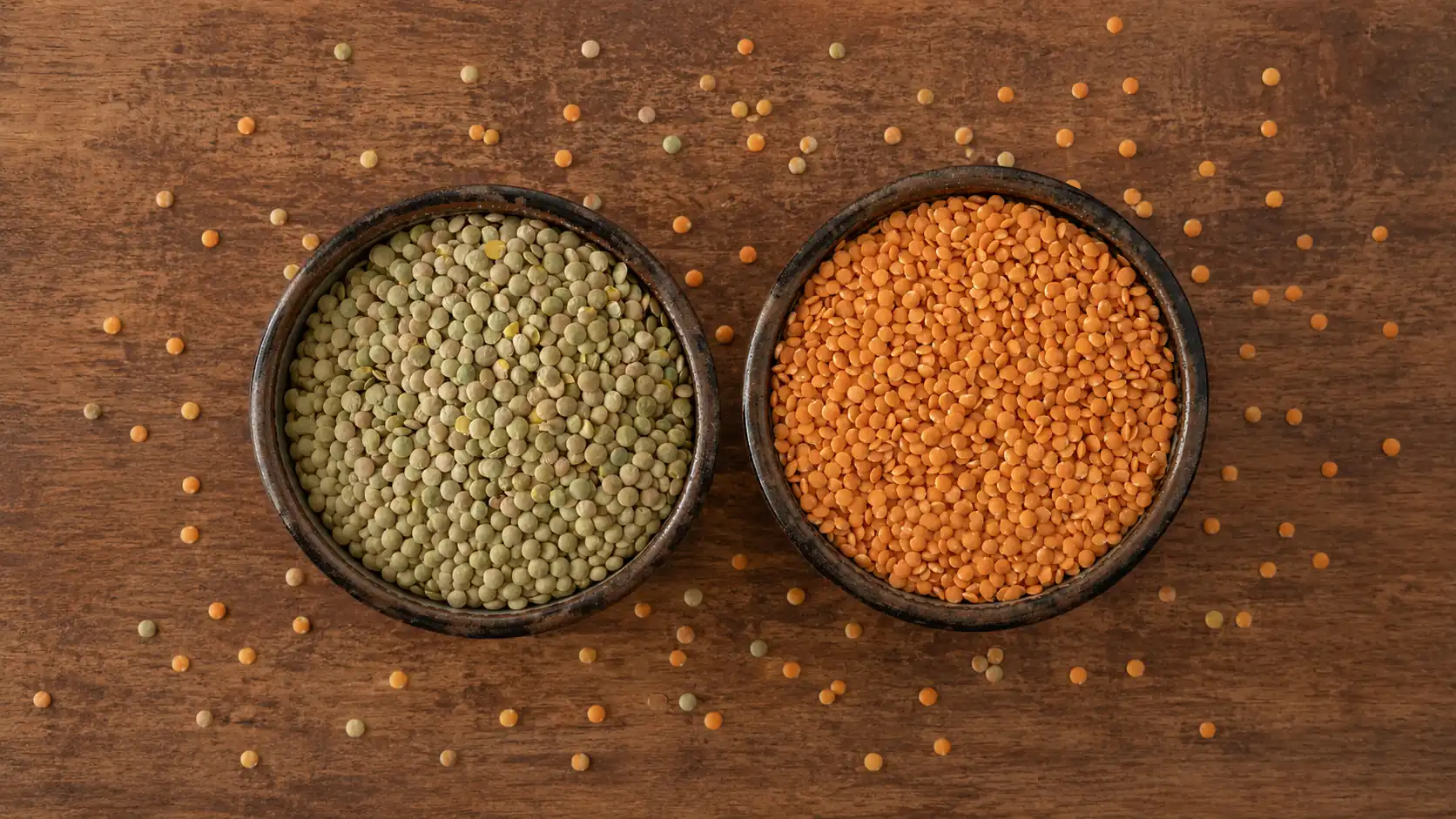
Green lentils are whole, unhulled lentils with a green to greenish-brown seed coat. Depending on origin and crop year, the size can range from small (often referenced as Eston or French-style green types) to large (Laird type), and the colour can vary from pale green to a darker, more mottled green.
Commercially, green lentils are valued for their ability to hold shape after cooking. This makes them well suited to salads, ready-meals, canned products, soups where visible texture is required, and retail packs aimed at consumers who recognise the whole lentil as a premium pulse.
For importers, the relevant trade points generally include:
- whole seed integrity and split percentage
- colour consistency within the lot
- sieve size, specified in millimetres and confirmed before quotation
- moisture content, within a range suitable for safe storage, subject to batch specification
- foreign matter and total defects, defined in the contract
Green lentils are produced in several origins, including Canada, Russia, Kazakhstan, and Turkey, with other producing regions active depending on crop year, programme availability, and exportable surplus. Origin selection should be confirmed against current market conditions at the time of inquiry.
What Are Red Lentils?
Red lentils are lentils with a red to orange cotyledon. In the field, the seed coat is generally tan or brown. Once the seed coat is removed, the bright red or orange kernel becomes visible, and this is the form most buyers in the MENA region, the CIS, South Asia, and parts of Africa actually purchase.
Red lentils are traded mainly in two processed forms: split and whole (the latter referenced in trade as football lentils). The choice between them is driven by the end product and by cooking traditions in the destination market.
Red lentils cook faster than green lentils and tend to break down into a softer, thicker texture. For this reason they are widely used in dal preparations, purées, soups, baby food formulations, and instant or semi-instant meal products.
Split Red Lentils
Split red lentils are red lentils that have been dehulled and mechanically split into two halves. The result is a flat, lens-shaped kernel with a bright red to orange colour.
For food processors, split red lentils offer several practical advantages:
- short cooking time, useful for ready-to-eat and instant product lines
- uniform absorption of water and flavour
- consistent visual appearance in finished retail packaging
- predictable behaviour in extrusion, milling, and flour production
Quality parameters that buyers typically specify include splitting percentage, polish level, broken percentage, colour brightness, moisture, and absence of unhulled seeds. Exact figures depend on origin, processing plant, and crop year, and should be confirmed before quotation.
Demand for split red lentils is well established in markets such as Iran, Iraq, the Gulf, Egypt, and parts of North Africa, alongside food-processing buyers in Europe sourcing for private-label and industrial use.
Red Football Lentils
Red football lentils are whole red lentils that have been dehulled but not split. The kernel remains round, which gives the product its trade name. Visually, the lentil looks like a small red sphere with a smooth, polished surface.
Football lentils are preferred when the buyer wants the cooking speed and colour of red lentils, but also wants the kernel to retain shape in the finished product. They are commonly used in:
- traditional dishes where whole red lentils are visually expected
- premium retail packs
- selected canned and ready-meal applications
- markets where consumers distinguish between split and whole red lentils on the shelf
Football lentils may trade at a different price level than split red lentils, depending on processing yield, origin, quality, and current demand. Actual price relationships move with the market and should be checked at the time of inquiry. Buyers should request the specific origin, crop year, and processing standard before finalising any contract.
Key Differences Between Green Lentils, Split Red Lentils, and Red Football Lentils
The table below summarises the main commercial and technical differences. Specific figures are indicative and should be confirmed against the actual contract specification and the relevant batch.
| Parameter | Green Lentils (whole) | Split Red Lentils | Red Football Lentils |
|---|---|---|---|
| Form | Whole, with seed coat | Dehulled, split into halves | Dehulled, whole kernel |
| Colour | Green to greenish-brown | Bright red to orange | Bright red to orange |
| Cooking behaviour | Holds shape | Softens, breaks down | Cooks fast, holds shape |
| Typical end use | Salads, soups, ready-meals, canned | Dal, purées, soups, instant meals, baby food | Whole-lentil dishes, premium retail, canned |
| Main buyer segments | Europe, North America, Middle East retail, food service | MENA, CIS, South Asia, processors | MENA, Gulf, selected ethnic retail channels |
| Price relationship | Varies by origin, crop year, size, and market demand | Varies by processing cost, demand, and availability | Varies by processing yield, quality, and destination market |
| Packaging | 25 kg, 50 kg, big bags, bulk containers | 25 kg, 50 kg, big bags, bulk containers | 25 kg, 50 kg, big bags, bulk containers |
| Sensitivity to colour consistency | High | High | Very high |
This is a working comparison, not a substitute for a contract specification sheet. Each lot should be evaluated on its own documentation.
Which Lentil Type Is Better for Food Processing?
There is no single answer, and any supplier who gives one without asking about the production line is not taking the buyer’s process seriously.
For canned products and ready-meals where visible lentils are part of the value proposition, green lentils and red football lentils tend to perform better, since they hold shape during thermal processing. For soups, purées, baby food, and instant meal bases, split red lentils are often the more efficient choice, given their faster hydration and softer texture.
Processors running flour and ingredient lines frequently prefer split red lentils for milling, while pet food and feed-grade applications may accept off-spec or lower-grade material under separate contract terms. Retail packers focused on premium SKUs often combine all three categories in their assortment to cover the full consumer use case.
The decision should start from the finished product, then move backwards into the raw material specification, not the other way around.
Packaging and Shipment Considerations
Packaging is rarely a neutral topic in lentil contracts. It affects landed cost, handling at port, storage life, and shelf presentation.
Common packaging formats include:
- 25 kg PP or paper bags, frequently used for retail-bound and food-processing buyers
- 50 kg PP bags, common in wholesale and bulk distribution
- 1,000 kg or 1,250 kg big bags (FIBC), used for industrial buyers and processors with bulk intake
- bulk containerised shipments with liner bags, where the buyer’s facility can receive and handle loose product
Shipment basis is generally agreed on FCA, FOB, CFR, or CIF terms, with the choice depending on the buyer’s logistics setup and the origin. Container loadability is influenced by bag size, palletisation, and the specific origin port, and should be confirmed before booking.
Labelling, marking, fumigation, phytosanitary certification, and origin documentation are part of the standard trade file and should be aligned in the contract. For sensitive destinations, pre-shipment inspection is often built into the LC or contract terms.
At Terraviis, we supply, manage, and coordinate lentil shipments across origins and destinations, including bulk red and green lentils supply for processors, packers, and importers operating in MENA, CIS, Africa, and other international markets.
Quality Parameters Buyers Should Check Before Import
A clean contract specification protects both sides. The parameters below are among those most frequently disputed at destination when they are not properly defined upfront.
- Moisture content, defined as a maximum percentage, subject to batch specification.
- Foreign matter, including stones, soil, plant residue, and other extraneous material.
- Broken or damaged kernels, defined as a maximum percentage by weight.
- Splits in whole lentil contracts, or unhulled grains in dehulled lentil contracts.
- Colour consistency, ideally referenced against a retained sample.
- Insect damage and live infestation, with zero tolerance for live insects in most contracts.
- Mycotoxin and pesticide residue compliance, aligned with the destination market regulation.
- Sieve size and uniformity, particularly relevant for green lentils.
- Crop year, since older crop behaves differently in cooking and storage.
Independent inspection at loading is a sensible default for new trade flows. Recognized inspection companies issue weight, quality, and stuffing reports that protect the importer in case of a claim. For sensitive shipments, inspection by SGS, Baltic Control, or another recognized independent inspection company can be arranged, where agreed or required by the buyer. This sits within our broader quality control and food safety approach, which we apply across pulses and other agricultural commodities on a contract basis.
Conclusion
Green lentils, split red lentils, and red football lentils are not interchangeable products. They differ in origin, processing, cooking behaviour, packaging logic, and end-market expectation. For importers and food processors, getting the category right is the first decision. Getting the specification, packaging, and inspection right is the second.
A serious procurement process starts with the finished product, defines the specification accordingly, and selects a counterparty that can execute the contract from origin to destination with consistent documentation and quality control. That is the standard B2B buyers should expect from any supplier or trading counterparty handling pulses at industrial volumes.
For buyers preparing an upcoming lentil program, our team is available to review specifications, suggest suitable origins for the current crop year, and prepare an offer aligned with the intended end use and destination. To discuss volumes, origins, and shipment terms, contact the Terraviis trade desk.